Blog
From pilot to full scale automation: Key strategies from the 11th annual State of Smart Manufacturing report
Industrial operations are becoming more complex, with rising costs, labor constraints, and ongoing supply chain fragility reshaping how manufacturers compete. What’s changed is not the pressure itself, but how leaders are responding to it.
In Rockwell Automation’s 11th annual State of Smart Manufacturing report, more than 1,500 global manufacturing leaders confirm that shift: digital transformation has moved from a strategic initiative to a core requirement for operating and scaling effectively.
90% of respondents say digital transformation is necessary to stay competitive, with 70% of non-adopters planning to invest within the next 12 months.
The report highlights how manufacturers are moving beyond adoption, using technology to execute, scale, and drive measurable operational outcomes.
From pilot to performance: How manufacturers are scaling what works
Smart manufacturing is moving out of the pilot phase, with the share of organizations in this phase at just 18% this year, signalling a clear shift toward scaled deployment in live operations.
Smart manufacturing is moving from pilots to production; this year, only 18% of respondents reported they were in the pilot phase with smart manufacturing technologies while 59% reported these tools are used actively to support operations.
11th annual State of Smart Manufacturing Report, page 8
This marks a shift from experimentation to execution. Rather than testing what might work, manufacturers are increasingly focused on scaling what already delivers value and replicating proven use cases across their operations. Manufacturers are prioritizing initiatives that align digital transformation efforts directly with core business KPIs.
0%
of manufacturers are prioritizing reducing costs through transformation efforts.
0%
of manufacturers are prioritizing improving quality through transformation efforts.
0%
of manufacturers are prioritizing reducing operational risk through transformation efforts.
3 capabilities manufacturers are prioritizing to transform operations
As manufacturers shift from pilots to scaled execution, the focus is moving from adopting smart manufacturing technologies to using them consistently to drive operational performance. Here are three of the core enablers that are transforming digital investment into efficiency gains, resilience, and sustained performance.
1. Investing in AI and automation to shape intelligent operations
Manufacturers are increasingly investing in AI and automation to improve quality, strengthen cybersecurity, and optimize operational performance across production environments. Rather than limiting automation to fixed or isolated use cases, organizations are embedding these technologies into core operations that drive day-to-day execution.
In fact, to drive positive business outcomes over the next five years, 46% of respondents plan to implement AI/ML and 40% plan to increase automation.
2. Equipping people for a more adaptive, intelligent future
As operations become more intelligent, the most successful manufacturers are actively investing in workforce transformation, reshaping roles and reskilling talent to work alongside advanced technologies. In fact, 93% of respondents expect to reshape their workforce as smart manufacturing advances, reflecting a structural shift toward more dynamic, adaptable models.
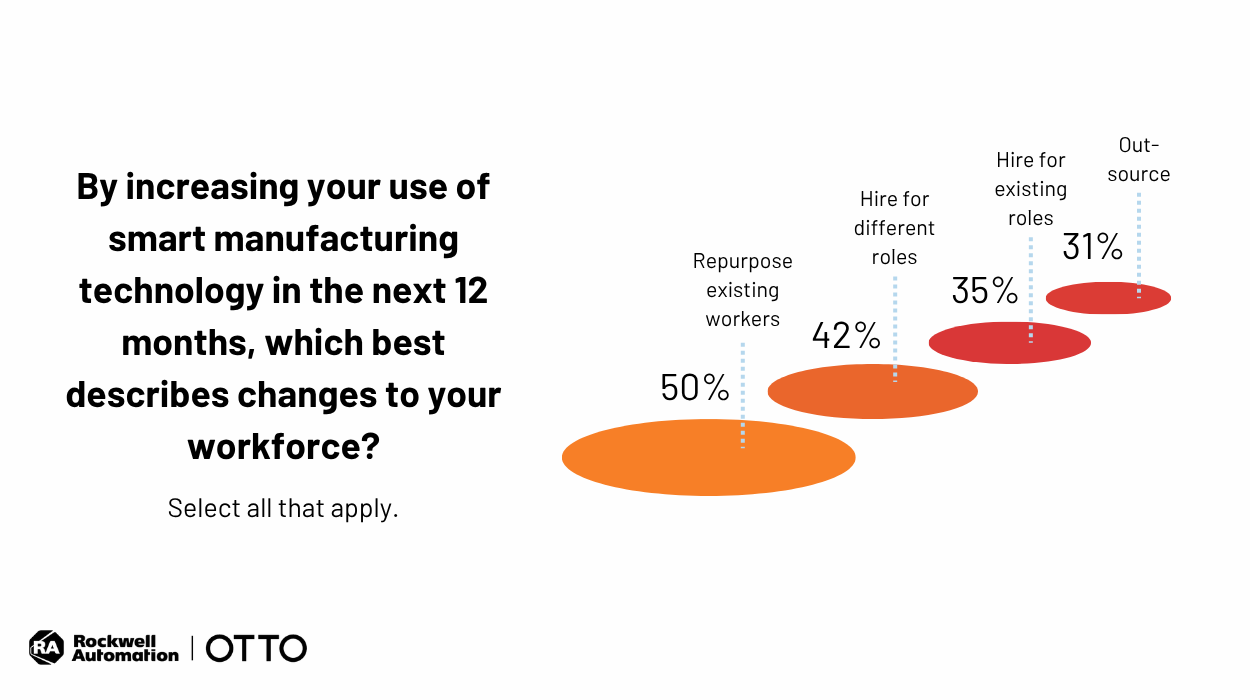
Image 1: Based on results from the 11th annual State of Smart Manufacturing report, most manufacturers are planning to repurpose their existing workers when deploying smart manufacturing technology.
3. Integrating proven technologies for competitive differentiation
Technology adoption alone no longer defines performance. With smart manufacturing now widely adopted across the industry, the differentiator is how effectively organizations connect and integrate these capabilities across their plant to solve operational challenges.
High-performing organizations are investing across a broad set of smart manufacturing technologies, including:
- Cobots (65%)
- Autonomous mobile robots and automated guided vehicles (69%)
- Digital twins, simulation, emulation (69%)
- Robotics (74%)
- AI/ML (83%)
Rather than piloting new solutions, manufacturers are focusing on aligning their technology, workforce, and end-to-end processes to improve speed, quality, and reliability across operations.
To explore two more capabilities manufacturers are using to drive operational performance, download the full State of Smart Manufacturing report.
Subscribe to our newsletter
Stay in the loop on product news, case studies, upcoming events and more.
Please allow all cookies to access this form.